How to Weld HDPE Geomembrane: Methods, Machines and Best Practices
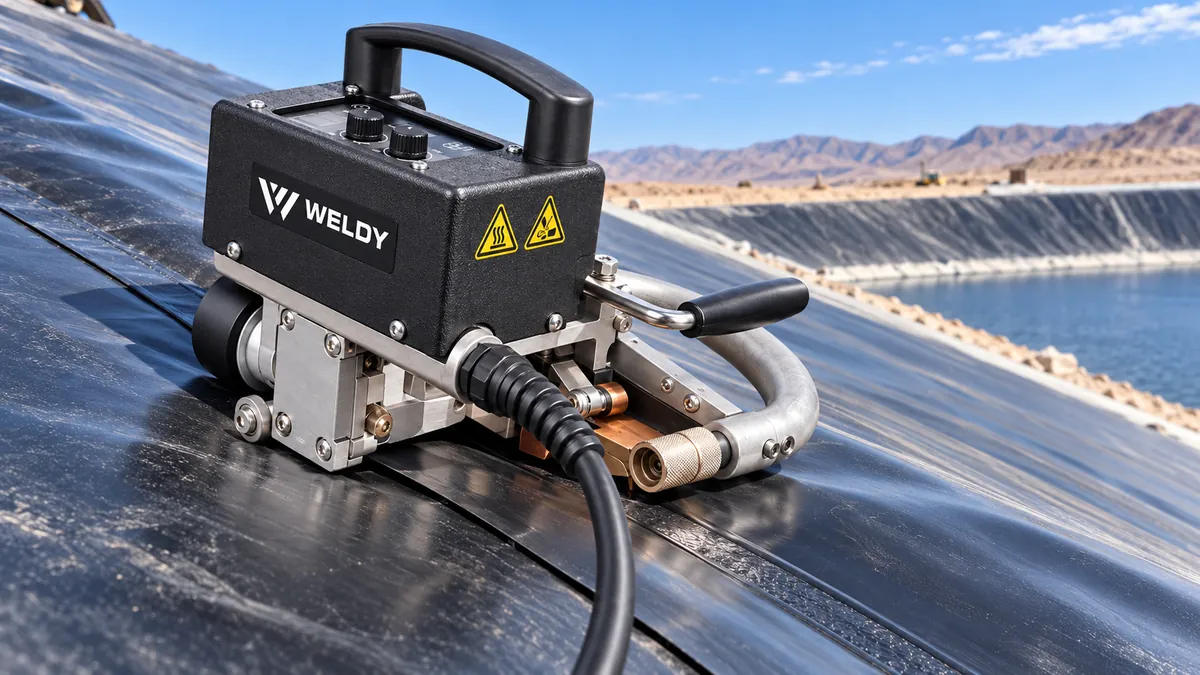
HDPE geomembrane is the standard lining material for ponds, landfills, reservoirs and tanks across the UAE and GCC — and the quality of a lining project lives or dies on its welds. This guide walks through the two welding methods every installer uses, the machines behind them, and the practices that produce seams that pass testing the first time.
The two welding methods
1. Hot-wedge welding — for long seams
A hot-wedge machine drives itself along the overlap of two membrane sheets, heating both surfaces with a metal wedge and pressing them together between rollers. The result is a dual-track seam with an air channel between the tracks, which is later pressure-tested. This is how 90% of a project's seam length is welded. Machines like the Weldy Miniwelder GEO 2 handle standard liner thicknesses, while the Weldy WGW 300 brings 1750 W of power for thick membranes on large civil projects.
2. Extrusion welding — for details and repairs
Corners, pipe penetrations, patches and T-joints cannot be reached by a wedge machine. Here a hand extrusion welder deposits molten HDPE welding rod over the joint. The Weldy Booster EX3 is the workhorse for this — 3.4 kg/h output at only 6.9 kg — with the EX3 Plus for continuous heavy-duty work.
Welding parameters that matter
- Temperature: HDPE welds around 220–260 °C at the wedge; always verify with trial seams at the day's ambient temperature.
- Speed: too fast gives cold seams, too slow scorches the membrane. Run a trial seam and peel-test it before production welding.
- Pressure: roller pressure must squeeze out a small, even bead along the seam edges.
- Cleanliness: dust and moisture are the main cause of failed seams — grind and dry extrusion joints, keep wedge paths clean.
Testing your seams
Dual-track wedge seams are air-pressure tested; extrusion seams are spark-tested or vacuum-box tested. Keep records per seam — most UAE project consultants require them.
Common mistakes to avoid
- Welding over dusty or damp overlap areas
- Skipping trial seams after weather changes
- Using worn wedges or dirty welding shoes — see our maintenance guide
- Choosing the wrong method for the joint — our wedge vs extrusion comparison explains when to use each