Wedge Welding vs Extrusion Welding: Which Method Do You Need?
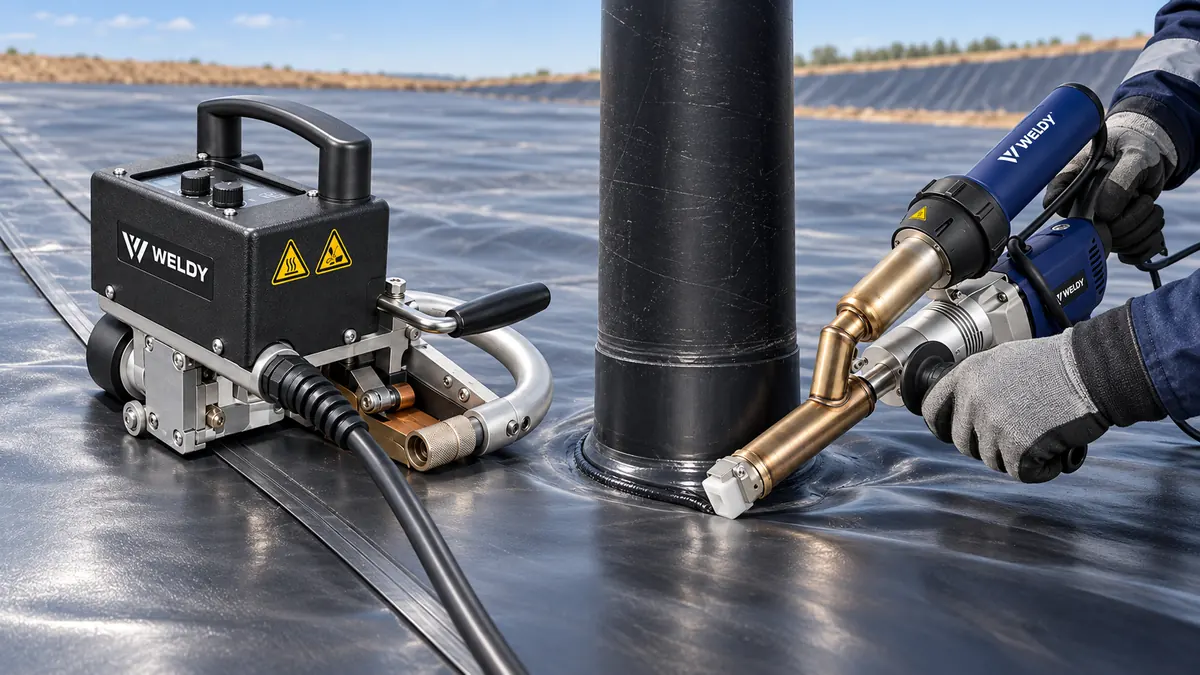
Every geomembrane installer eventually asks the same question: wedge or extrusion? The honest answer is that a serious lining crew needs both — they do different jobs. Here is exactly where each method fits.
What hot-wedge welding does
A wedge welding machine is a self-propelled unit that welds the long, straight overlaps between membrane panels. It produces a consistent dual-track seam at walking pace, with a test channel for quality control. For production seaming it is unbeatable — fast, repeatable and testable.
Machines: the Miniwelder GEO 2 (compact, 7 kg, for standard HDPE and PVC liners) and the WGW 300 (1750 W, for thick membranes and demanding sites).
What extrusion welding does
An extrusion welder is a hand-held machine that melts HDPE welding rod and deposits it as a bead over the joint. It goes where the wedge machine cannot: patches, repairs, pipe boots, corners, sumps and connections to structures.
Machines: the Booster EX2 (compact, 2.5 kg/h), the best-selling Booster EX3 (3.4 kg/h at 6.9 kg) and the EX3 Plus for all-day fabrication work.
Side by side
| Hot-wedge | Extrusion | |
|---|---|---|
| Best for | Long panel seams | Details, repairs, penetrations |
| Speed | 1.5–5 m/min, self-driven | Manual, bead by bead |
| Testing | Air channel pressure test | Spark / vacuum box test |
| Consumables | None (heat + pressure) | HDPE welding rod |
| Skill level | Operator setup, machine runs | Welder technique matters |
So which do you buy first?
If you install liners: both — a typical crew runs one wedge machine and one or two extruders. If you fabricate tanks, ducts or plastic parts in a workshop, you may only need extrusion welding plus a hot air tool for tacking. Read our full HDPE welding guide for how the two methods work together on site.