Pond & Lagoon Liner Installation in the UAE: The Welding Stage
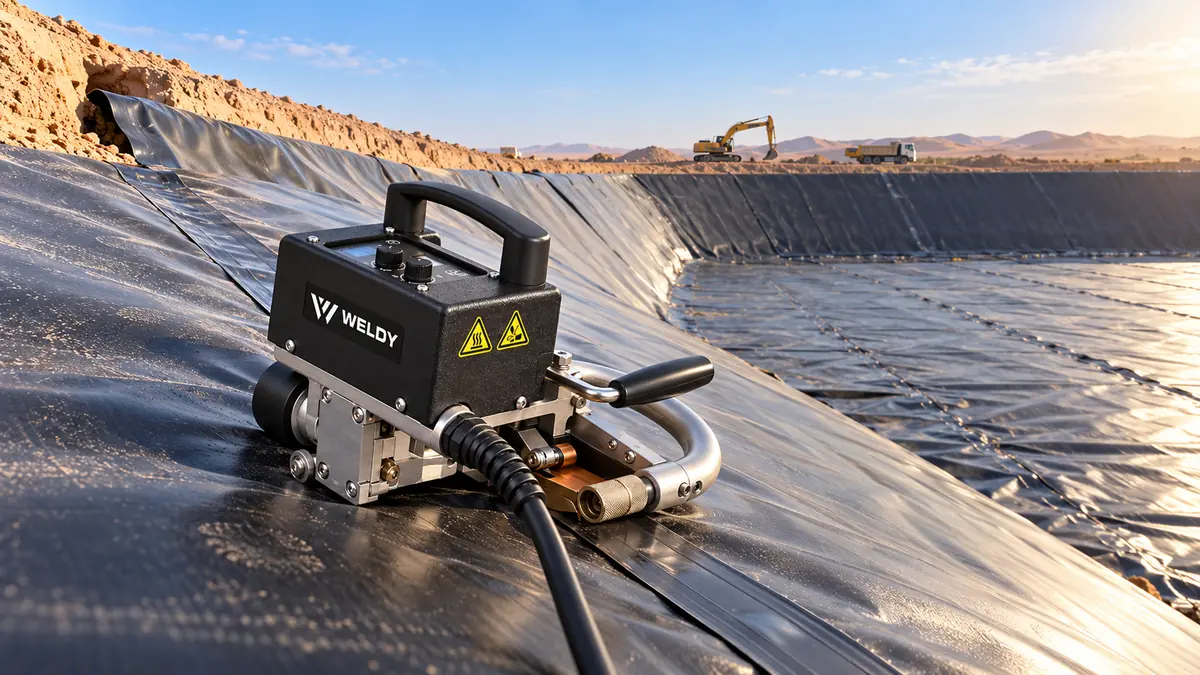
From irrigation ponds in Al Ain to leachate lagoons and fish farms, HDPE-lined water bodies are everywhere in the Emirates — and the welding stage is where a liner project succeeds or fails. Here is how professional crews run it.
1. Panel layout and prep
Panels are deployed to minimize total seam length and keep seams running down slopes, not across them. Overlaps of 100–150 mm are standard. Before any welding: clean overlaps, trial seams, and peel tests on the day’s settings.
2. Production seaming — hot wedge
The long overlaps are welded with a self-propelled wedge welding machine — a Miniwelder GEO 2 for standard liner thickness, or a WGW 300 for thick membranes. The dual-track seam leaves an air channel used for pressure testing every seam.
3. Details — extrusion welding
Inlet and outlet pipes, sump corners, anchor trench terminations and any patch are welded with a hand extrusion welder like the Booster EX3: grind the surface, preheat, and deposit the rod bead. Details are usually 5% of seam length and 50% of the skill — if your crew is new to this, our HDPE welding guide covers technique.
4. Testing and handover
- Pressure-test every wedge seam via the test channel
- Spark-test or vacuum-box every extrusion weld
- Record seam numbers, operators and results — consultants will ask
The equipment list for one crew
| Step | Machine |
|---|---|
| Panel seams | GEO 2 or WGW 300 |
| Details & repairs | Booster EX3 |
| Tacking & small work | Energy HT1600 |